The Digital Reality Gap
The difference between what your company is and how the internet represents it.
Your company has changed. Has the internet kept up? Buyers now meet the version of you that search and AI assemble from public evidence.
What is the Digital Reality Gap?
The Digital Reality Gap is the difference between what a company is and how it appears online.
Search engines and AI systems describe your company from public evidence. When that evidence falls behind the business, they represent a version of you that no longer exists.
You cannot fix that with a better prompt. You fix it by making the evidence current.
Map it. Check it. Measure it. Monitor it. The first two you run yourself in an afternoon. The last two are optional.
The Digital Reality Canvas
A one-page template for mapping the three realities side by side. Fill in what is true and what you say, then what the internet actually shows. The distance between them is your gap.
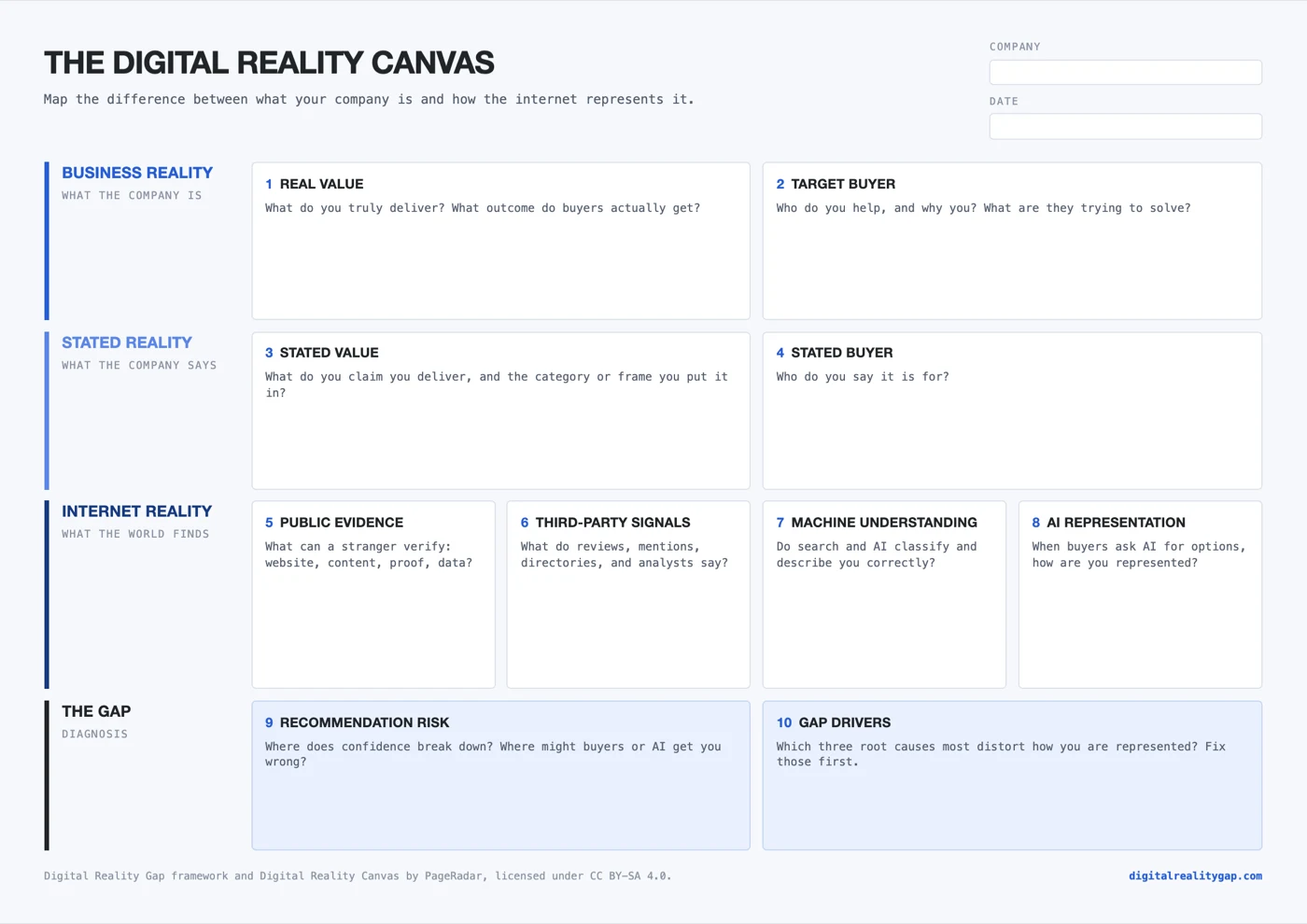
One page, ten blocks, four bands. Print it, fill it with your team, and read the distance between the top and the middle.
Download the Digital Reality CanvasMark where every answer came from
A Canvas is only as good as the evidence under it. Label each cell with its source before you read the gap.
- Declared
- Supplied by the company. Blocks 1 and 2 can only ever be this.
- Observed
- Found on the company’s own properties: site, docs, product pages.
- Perceived
- Synthesised from what AI systems actually answered.
- Evidenced
- Supported by a third-party source you can cite.
- Unknown
- Not enough evidence. A real answer, and often the finding itself.
Two cells labelled differently are not the same claim. A gap between Declared and Perceived is the framework working; a gap between Unknown and Unknown is homework.
Catch data incidents before they reach dashboards and executives.
DeclaredData-platform leads, accountable for trust in the numbers.
Declared“The data observability platform that catches issues before your executives do.”
ObservedData-platform leads.
ObservedThe homepage still leads with “move data faster”. Case studies describe faster loads and lower cost, not incidents caught.
ObservedG2, Crunchbase and two directories all file Northwind under the old category. Older reviews praise pipeline speed; none mention observability.
EvidencedAsked directly, AI describes Northwind as “an ETL and data-pipeline tool”.
PerceivedNot named in the unbranded observability questions. Three competitors were.
PerceivedBuyers who ask AI for observability options never see Northwind. The ones who do arrive expecting a pipeline tool and get compared against the wrong competitors.
JudgementCategory & Positioning first. Behind it, an outdated public record: homepage, proof and third-party profiles all still describe the previous company.
JudgementRead the distance: The first two bands describe an observability company. The third describes a pipeline tool. Nothing here is a mistake by the models: every source they could read was still telling the old story.
See how they found itWhat the Canvas helps you find
Eight mismatches, each read between two blocks on the Canvas.
You deliver more than your own messaging claims.
Real Value ↔ Stated ValueWho you serve and who you say you serve have drifted apart.
Target Buyer ↔ Stated BuyerYou are classified differently from how you sell.
Stated Value ↔ Machine UnderstandingThe value is real. The public proof is thin.
Real Value ↔ Public EvidenceOld pages and profiles still describe a previous company.
Business ↔ Internet RealityYour sources contradict each other, so nothing resolves cleanly.
Machine Understanding ↔ Third-Party SignalsAI reads you correctly and still recommends someone else.
AI Representation ↔ Third-Party SignalsAI describes you inaccurately, or leaves out what matters.
Real Value ↔ AI RepresentationRun a Digital Reality Check
The Canvas maps the gap. The Check reveals it, using the same public evidence your buyers see. One afternoon, no tools.
Ask AI: "What are the best options for [the problem your buyer is solving]?"
If you are not in the answer, you have a gap.
AI and search are rarely randomly wrong. They reflect the evidence available to them.
Record what you observed, not what you concluded
NeverOur positioning is confused.
InsteadWe describe ourselves as an AI security platform. Across three models, we were most often described as an endpoint security company.
Note the models, the date, and how many times you ran each query. Observation survives the meeting. Judgement starts an argument in it, and a Check with no run date cannot be compared to the next one.
What the Check produces: A Canvas Readout, not a score · Likely gap drivers · Recommendation risks · Your top three next moves
Measure it, then watch it
The Canvas and the Check are the whole free path. If you came to see your gap and leave with three moves, you are done. These two stages are optional: they turn the same eight dimensions into a number, then repeat it so drift shows up before your buyers notice.
Measure the gap
The Check reveals the gap. Measuring turns the same eight dimensions into a score, so you can compare periods and competitors instead of comparing impressions.
- Score from public evidence, never from the Canvas. A self-generated number measures your opinion of yourself.
- Score all eight dimensions. One headline number hides which one is failing.
- Benchmark against named competitors. Being absent only means something relative to who is present.
- Record the evidence behind each score, so the next run is a comparison and not a fresh guess.
- Publish the band and the confidence level with the number. A score standing on two sources and a score standing on twenty are not the same claim.
Higher is better
The score measures alignment: 100 would mean the internet represents the company exactly as it is. Publish it with a band, never on its own.
- 85–100Aligned
- 70–84Minor gap
- 50–69Moderate gap
- 0–49Significant gap
A number implies a precision the evidence rarely supports. The band is the honest part, and it is what survives being repeated.
The same eight the Canvas helps you find. See the eight
Dimensions 7 and 8 are measured as AI Share of Voice: how often you are named across AI platforms for your buyers’ questions, against the competitors named instead.
Watch it over time
A measurement is a snapshot. Representation drifts: pages age, competitors publish, models retrain. Monitoring is the same measurement repeated on a cadence, so you find out before your buyers do.
- Re-run on a fixed cadence. Quarterly is enough for most companies, because AI answers move faster than rankings but slower than news.
- Keep the query set and the competitor set fixed, or you are measuring a different thing each time.
- Track competitor movement, not only your own. A flat score while a rival climbs is a loss.
- Watch for drift after the events that cause it: launches, rebrands, migrations, leadership changes.
Not another AI visibility score
AI visibility asks whether you appear in AI answers. The Digital Reality Gap asks whether the company being described is the one that exists.
- Published queriesThe exact eleven questions, the two-chat protocol, and how to tally them.
- Repeated observationsAI answers vary. One run is an anecdote, so the method asks for repetitions and a date.
- Evidence before judgementRecord what was observed and where, separately from what you concluded it means.
- Open licenceFramework and Canvas under CC BY-SA 4.0, commercial use included.
Digital Reality Gap framework and Digital Reality Canvas by PageRadar, licensed under CC BY-SA 4.0.